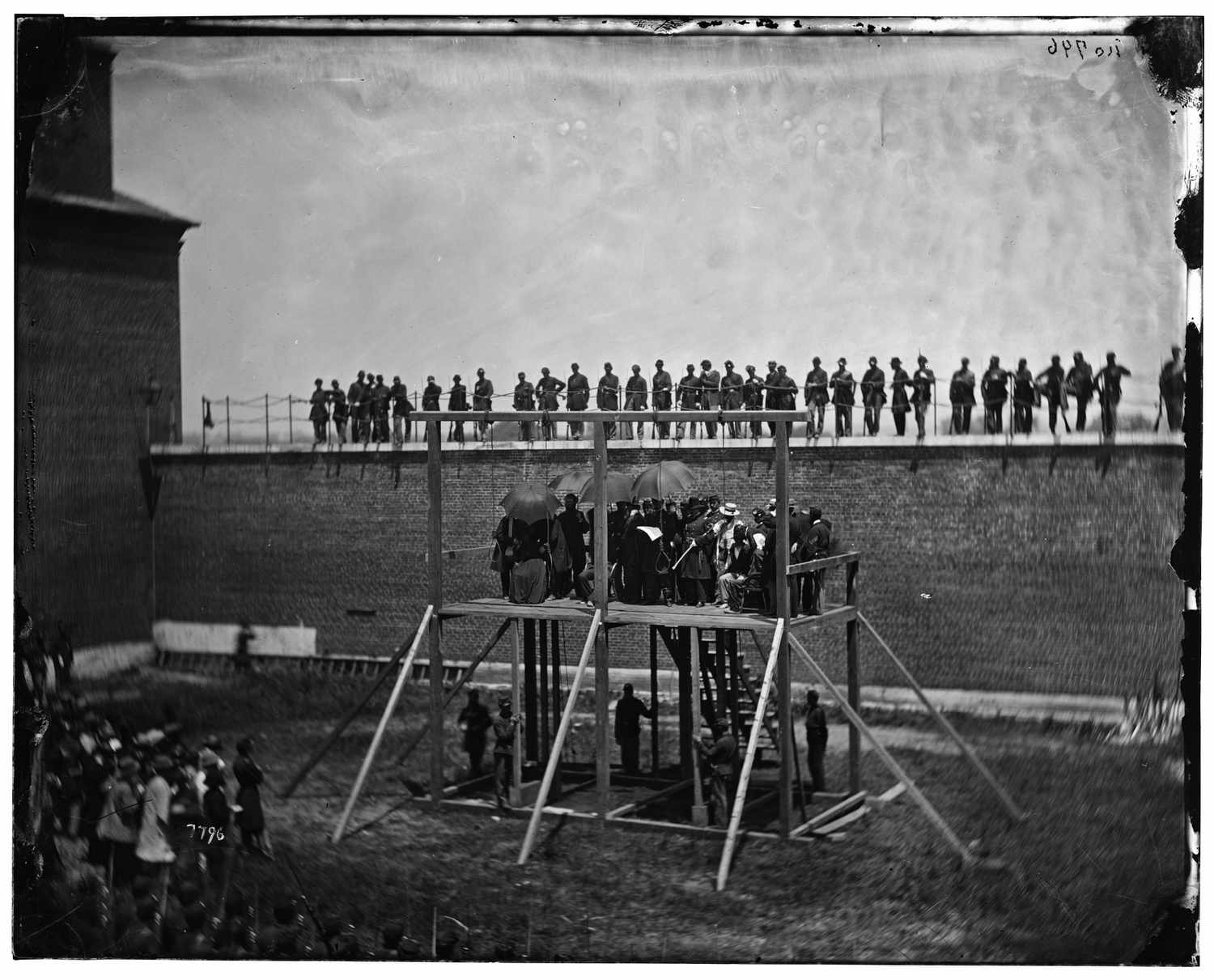
On July 6, 1865, an Army officer walked into a cell at the Old Arsenal Penitentiary in Washington, D.C., and read Mary Surratt her death warrant. The forty-two-year-old boarding-house keeper — a Maryland widow and Catholic convert — was told she would hang the next morning, alongside three men convicted with her of conspiring to murder President Abraham Lincoln. She had insisted on her innocence throughout the trial, and she insisted on it still. Within twenty-four hours she would become the first woman executed by the United States federal government, on grounds that are today part of Fort McNair.
The road to that cell had begun less than three months earlier. On April 14, 1865, John Wilkes Booth shot Lincoln at Ford's Theatre — the centerpiece of a coordinated scheme to decapitate the federal government. The plan called for Vice President Andrew Johnson to be killed at the Kirkwood Hotel — an assignment given to George Atzerodt — and Secretary of State William H. Seward to be attacked at his home. Booth and his associates were not strangers to Mary Surratt. Her Washington boarding house had become a meeting place for the men who plotted with him, and Booth himself was a familiar visitor.
Surratt's alleged part in the conspiracy turned largely on her property and her errands. On the morning of the assassination, Booth asked her to carry a package to her former tavern in Maryland, an errand the prosecution said was proof of her knowledge of the plot. The package included field glasses. Her defenders argued that she was simply doing a favor for a regular guest, with no idea of what he intended — an innocent errand made damning only in hindsight.