Julius and Ethel Rosenberg were convicted of conspiring to pass atomic secrets to the Soviet Union during and after World War II and were sentenced to death.[1, 2]
Check the sourcesWikipedia ↗HISTORY.com ↗
origin: imported
4 claims
Not yet independently verified

At 8:00 p.m. on June 19, 1953, Julius Rosenberg walked into the execution chamber at Sing Sing Prison in Ossining, New York. Minutes later, his wife Ethel followed. Within the hour, both were dead — the first American civilians executed for espionage during peacetime, killed on the charge that they had delivered the secrets of the atomic bomb to the Soviet Union.
The path to that execution chamber had begun three years earlier, in a cascade of confessions triggered by Klaus Fuchs, a German-born physicist who had worked on the Manhattan Project and who told British authorities in 1950 that he had passed atomic research to Soviet handlers. Fuchs led investigators to David Greenglass, a U.S. Army sergeant who had worked on atomic research at Los Alamos and who implicated his brother-in-law Julius Rosenberg. Julius — an engineer who had worked for the U.S. Army Signal Corps — was arrested on July 17, 1950. Ethel Greenglass Rosenberg, David's sister and Julius's wife since 1939, was arrested shortly after.
Their trial opened in March 1951 before Judge Irving R. Kaufman in the U.S. District Court for the Southern District of New York. Federal prosecutors Irving H. Saypol and Roy Cohn built their case primarily on Greenglass's testimony. He claimed, among other things, that Ethel had typed notes containing classified atomic information — a detail that placed her squarely in the conspiracy, but one that Greenglass himself would later dispute. He received a reduced sentence in exchange for his cooperation. On March 29, 1951, the jury convicted both Rosenbergs of conspiring to commit espionage under the Espionage Act of 1917. Judge Kaufman sentenced them to death on April 5, 1951, declaring from the bench that their conduct had contributed to the Korean War — a contention that went considerably beyond the evidence presented at trial.
Archival and public-source images gathered for this case, shown as found and marked unverified until a human checks rights and relevance. Not a rights clearance, endorsement, or complete record.
Each claim is sourced and shown by default. The mark beside it reads its status — a hollow ring (reported, awaiting review), a solid dot (human-verified), or an oxblood triangle (disputed). The numbered references point to the sources at the page bottom. Verification is human-only.
0 of 4 facts verified · help verify →
Julius and Ethel Rosenberg were convicted of conspiring to pass atomic secrets to the Soviet Union during and after World War II and were sentenced to death.[1, 2]
Check the sourcesWikipedia ↗HISTORY.com ↗
Klaus Fuchs's 1950 confession to British authorities about passing atomic secrets to the Soviets led investigators to David Greenglass, whose testimony in turn implicated Julius Rosenberg.[1]
Check the sourcesWikipedia ↗
Julius Rosenberg had worked as an engineer for the U.S. Army Signal Corps, a position that became central to the espionage charges against him.[1, 3]
Check the sourcesWikipedia ↗Jewish Women's Archive ↗
David Greenglass, a U.S. Army sergeant and Ethel Rosenberg's brother, confessed to passing atomic research from Los Alamos to Soviet intelligence through Julius Rosenberg and provided testimony against the couple.[1, 3]
Check the sourcesWikipedia ↗Jewish Women's Archive ↗
Sources opened and checked for this issue — not exhaustive, official, or a complete record. Numbers match the citation marks above.
Books, podcasts, articles, and films about this case — gathered as candidates and marked unverified until reviewed. These reflect each work’s own framing, not Case Bound facts or endorsements.


Book · 1973unverified
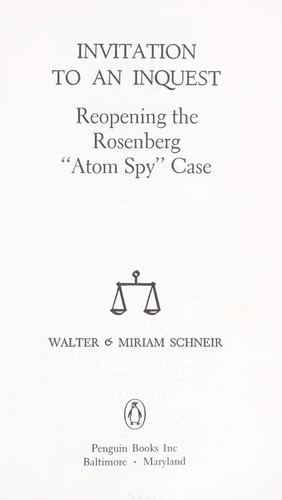
Invitation to an inquest; [reopening the Rosenberg "Atom Spy" case]
Walter Schneir, Miriam Schneir

Book · 1952unverified
Julius Rosenberg, Ethel Rosenberg, Morton Sobell, United States. District Court (New York : Southern District)
Podcast · 2026unverified
CONSPIRACY THEORIES: The Rosenberg Plot Pt. 2
Conspiracy Theories, Cults, & Crimes
Podcast · 2026unverified
CONSPIRACY THEORIES: The Rosenberg Plot Pt. 1
Conspiracy Theories, Cults, & Crimes
Podcast · 2026unverified
The Rosenbergs: "Atomic Spies" or Scapegoats? The Jewish Community’s Reckoning
Jewish History Nerds
Podcast · 2024unverified
Rosenbergs: Espionage, Secrets & the Trial That Shook America!
History Ignited: The Kids’ History Podcast Inspired by Billy Joel's We Didn’t Start the Fire
Podcast · 2024unverified
Classic Radio for February 15, 2024 - The Prisoners Song, The Big Tooth, and Wild Jack Rett
Classic Radio Theater with Wyatt Cox
Podcast · 2023unverified
The 2023 Sydney Taylor Book Awards, Revealed!
The Book of Life: Jewish Kidlit (Mostly)
Podcast · 2022unverified
Beto Can Win: Steve Phillips; plus Dave Lindorff on Atom Spies
The Nation Podcasts
Podcast · 2021unverified
Episode 266: Tynion IV: The Quest For Peace
Comics From The Multiverse (DC Comics Podcast)
Podcast · 2021unverified
The Book Club: Anne Sebba on the life and death of Ethel Rosenberg
Best of the Spectator
Podcast · 2016unverified
Author Debriefing: Executing the Rosenbergs: Death and Diplomacy in a Cold War World
SpyCast